
School Based ABA
Positive behavioral support is woven into the school day to help students build communication, coping, regulation, replacement behaviors, and successful participation.
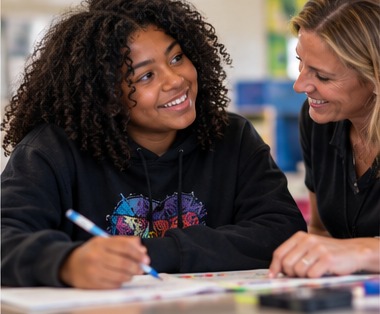

What This Means for Your Child
- Understand the function of behavior
- Teach meaningful replacement skills
- Support communication and self-regulation
- Practice skills in naturally occurring situations
At A-FITS, behavioral support is not something that happens only after a problem occurs. It is part of the educational environment.
Every student at A-FITS has access to school-based behavioral support, because communication, regulation, motivation, attention, flexibility, social interaction, and behavior all affect a student's ability to participate successfully in school.
Our approach uses principles of Applied Behavior Analysis (ABA) within the student's natural school environment to help students acquire new skills, reduce barriers to learning, strengthen communication, and become increasingly independent.
What Is School Based ABA?
Applied Behavior Analysis is the science of understanding how behavior is influenced by the environment and how learning occurs.
ABA uses observable information, reinforcement, teaching strategies, and data to help determine why a behavior may be occurring, what skill the student may be missing, what environmental factors may be contributing, what support or replacement skill could help, and whether the intervention is actually working.
At A-FITS, these principles are incorporated into everyday school routines—including academics, transitions, social situations, communication, recreation, sensory regulation, classroom participation, and life-skills instruction.
School Based ABA Is Different From Clinic-Based ABA
Clinic-based ABA and school-based ABA may use many of the same behavioral principles, but their environments and priorities are different.
A clinic may provide intensive one-to-one instruction in a highly controlled environment.
A school has a different responsibility. Students need to function within classrooms, communicate with teachers, interact with peers, transition between activities, tolerate changes, complete assignments, participate in groups, regulate themselves, and navigate the natural demands of everyday school life.
That is why A-FITS emphasizes ABA within the natural school environment.
Behavior Is Communication
What adults describe as a “behavior problem” can sometimes be a student's attempt to communicate something they do not yet have another effective way to express.
A student may be overwhelmed by sensory input, may not understand what is being asked, may be trying to escape a task that feels impossible, may need attention, or may not yet have the regulation, flexibility, or coping skill the situation requires.
Instead of stopping at “How do we make this behavior stop?” A-FITS staff are encouraged to ask:
“What is this student communicating, and what skill can we teach that works better?”
Behavioral Intervention Through School Based ABA
When communication difficulties, sensory overload, frustration, anxiety, limited coping strategies, or difficulty understanding expectations interfere with learning, A-FITS can use behavioral strategies to teach more effective alternatives.
Strategies may include Functional Communication Training, DRA, DRO, positive reinforcement, prompting and fading, modeling, shaping, task analysis, visual supports, Discrete Trial Teaching when appropriate, natural-environment and incidental teaching, antecedent modifications, and replacement-behavior instruction.
The strategy is not the goal. The student's ability to communicate, regulate, participate, and become more independent is the goal.
Skill Acquisition Through ABA
ABA is also used to teach new skills in areas such as communication, attention and participation, motivation, observation and discrimination, and independence.
Complex skills can be broken into smaller, manageable components and taught systematically before being combined into more functional abilities.
The important part is that those skills should not remain isolated. Students need opportunities to use what they learn throughout the school day.
Social Skills Through ABA
Students with autism may need explicit instruction in skills that other students acquire more naturally through observation and experience.
Those skills may include greetings, conversation, taking turns, joining an activity, sharing interests, reading social situations, personal space, flexibility, conflict resolution, cooperative play, working in groups, and building friendships.
A-FITS combines direct instruction with incidental teaching and naturally occurring social opportunities throughout the school day.
Generalization Matters
A student demonstrating a skill with one staff member does not necessarily mean the student can use that skill with everyone.
A-FITS intentionally creates opportunities for students to practice skills with different people, in different environments, during different activities, and under different circumstances.
The better question is not simply “Can the student demonstrate this skill during teaching?”
It is “Can the student use this skill when life actually requires it?”
Behavioral Support for Every Student
A-FITS does not view behavioral support as something reserved only for students experiencing significant behavioral challenges.
Every student can benefit from adults who understand reinforcement, motivation, communication, environmental supports, skill acquisition, and the principles that influence learning.
The level of support is individualized, but the behavioral expertise exists throughout the school environment.
ABA Is Embedded Into the A-FITS Day
A-FITS staff use behavioral principles throughout the student's educational experience—not only during a designated “ABA time.”
That can happen during academics, transitions, lunch, electives, playground time, social activities, life-skills instruction, and the ordinary moments of the school day where some of the most meaningful learning actually occurs.