
FITS Integrated Support™
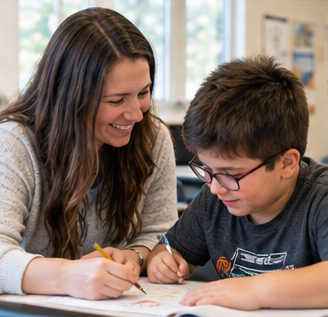
At A-FITS, support is not something students leave the classroom to go receive. It is part of the school experience.
Speech, Occupational Therapy, School Based ABA, Sensory Integration, Social-Emotional Learning (SEL), Transition Planning, teachers, and classroom support staff work together around the same student.
Communication affects academics. Sensory needs can affect behavior. Emotional regulation can affect relationships. Behavior can communicate an unmet need. Life skills can affect independence. Transition skills developed today can influence what becomes possible after graduation.
Support Should Follow the Student
Traditional educational and therapeutic models can sometimes divide a student's day into separate pieces.
Academics happen in one place. Speech somewhere else. OT somewhere else. Behavior support when something goes wrong. Social skills during a scheduled lesson. Transition planning years later when graduation begins approaching.
A-FITS takes a different approach.
Whenever appropriate, we bring the expertise into the environments where students actually learn, communicate, interact, regulate, solve problems, and become more independent.
That means the entire school day becomes an opportunity for meaningful skill development.
Integrated Speech & Communication
Communication touches virtually every part of a student's life.
At A-FITS, Speech support can occur in classrooms, activities, social situations, transitions, and other naturally occurring parts of the school day.
A communication strategy introduced by Speech can then be reinforced by teachers, paraprofessionals, behavior staff, and other adults supporting the student.
The goal is not simply: “Can the student demonstrate this skill during Speech?”
The better question is: “Can the student communicate when life actually requires it?”
Occupational Therapy
Occupational Therapy supports many of the skills students need to participate successfully throughout their day, including fine-motor development, motor planning, handwriting, organization, self-care, classroom participation, daily routines, functional living skills, independence, and sensory processing.
Our Occupational Therapy professionals also help the rest of the A-FITS team better understand what may be creating a barrier for the student.
Instead of immediately asking, “Why isn't the student doing this?” we can ask: “What is making this difficult, and what could make participation more accessible?”
Sensory Integration
Sensory Integration is intentionally embedded into the A-FITS school experience.
Students are constantly processing information from their environment—sounds, lights, movement, touch, body position, textures, people, activity levels, and countless other forms of sensory input.
Our classrooms, sensory spaces, staff, and Occupational Therapy professionals work together to help identify what supports the individual student.
That may include sensory gym access, movement opportunities, heavy work, deep pressure, alternative seating, sensory tools, quiet environments, environmental modifications, structured sensory activities, individual sensory plans, and sensory diets when appropriate.
The purpose is to help students better understand and meet their sensory needs so they can participate more successfully in school and increasingly advocate for themselves.
School Based ABA
School Based ABA helps us understand learning and behavior within the environment where the student actually spends their day.
Our behavior professionals and school staff may use behavioral principles to understand why a behavior is occurring, what the student may be communicating, what skill may be missing, what environmental factor may be contributing, what replacement behavior could be taught, what reinforcement may support learning, and whether the strategy being used is actually working.
Behavioral support is not simply about decreasing behavior. It is about increasing communication, coping, participation, independence, and skills.
Social-Emotional Learning (SEL)
A student can have strong academic abilities and still struggle to understand emotions, relationships, frustration, flexibility, conflict, or how to navigate a complicated social environment.
That is why Social-Emotional Learning is integrated throughout A-FITS.
SEL can help students develop greater awareness of their own emotions, the emotions of others, coping strategies, problem-solving, relationships, conflict, flexibility, decision-making, self-awareness, self-advocacy, social expectations, and emotional regulation.
These skills are not limited to a worksheet or designated SEL period.
Social-emotional learning happens throughout real life, so we teach it throughout the real school day.
Transition Is Integrated Too
Transition planning is often associated only with high school. A-FITS does not wait that long.
Preparing for adulthood begins with the smaller independence skills students develop throughout childhood: following a routine, making a choice, caring for belongings, communicating a need, completing a task, solving a problem, helping with a classroom responsibility, making a purchase, learning self-care, and participating in the community.
As students get older, those foundations can develop into daily living skills, self-advocacy, community-based instruction, shopping and money skills, cooking, laundry, pre-vocational skills, work behaviors, career exploration, community participation, and independent-living skills.
We build toward adulthood throughout the student's time at A-FITS.
Classroom Support Connects Everything
Integrated support would not work if the knowledge remained only with specialists.
Teachers and paraprofessionals spend significant portions of the day with students. When Speech introduces a communication strategy, classroom staff can reinforce it. When OT develops a sensory plan, staff can help the student use it. When behavioral staff identify a replacement skill, everyone can respond more consistently. When a student is working on an SEL strategy or transition skill, adults can reinforce it in real situations.
This creates something extremely important: consistency.
Generalization Is One of the Goals
A student knowing a skill does not automatically mean they can use that skill everywhere.
FITS Integrated Support deliberately creates opportunities to practice skills with different people, materials, activities, routines, environments, and situations so the skill is not tied to only one adult or one classroom.
When appropriate, teams also work with families to understand how a skill is being used outside school and what may help it carry into home, community, recreation, future workplace, and adult-life settings.
Because independence is not: “I can do this when the right adult is standing next to me.”
Independence increasingly becomes: “I know what to do, and I can use the skill when I need it.”
Support Before Failure
A-FITS does not believe students should always have to fail significantly before receiving support.
A student may not meet a traditional qualification threshold for a specific service and still benefit from therapeutic, behavioral, sensory, social-emotional, or transition expertise.
The level of support will look different for every student. But the expertise exists within the environment.
Support can be proactive—not only reactive.
The School Needs to FIT Your Child.
Come experience A-FITS and talk with our team about your child's learning profile, strengths, support needs, and goals.
Schedule a Tour