
FITS Learning™
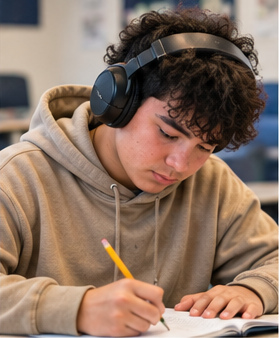
At A-FITS, we do not believe students should have to learn the same way in order to learn successfully.
FITS Learning™ is our individualized academic approach, designed to give students with autism meaningful access to education while recognizing that every student brings a different combination of strengths, challenges, interests, communication styles, processing needs, and academic abilities.
Some students may need significant instructional support. Others may be performing at or above grade level academically but need a different environment, teaching style, pace, or method of demonstrating what they know.
High Expectations. Individualized Access.
Individualizing instruction does not mean lowering expectations. It means changing how the student accesses the learning when necessary.
One student may understand a concept through traditional instruction. Another may need visual supports. Another may need hands-on materials. Another may benefit from additional processing time, repetition, smaller instructional steps, technology, or a different way to demonstrate mastery.
The destination may be similar. The path does not have to be.
At A-FITS, we want students to be appropriately challenged while also receiving the supports they need to experience meaningful success.
Accessible Academics
A-FITS provides academic instruction across the core subject areas while allowing instruction to be individualized around the learner.
Depending on the student, instruction may include direct instruction, small-group teaching, one-to-one support, multi-sensory instruction, hands-on learning, visual supports, technology-supported learning, project-based activities, independent tasking, whole-group instruction, repetition and practice, modified materials, and alternative response formats.
Teachers can use multiple instructional methods because students do not all process information in the same way.
The question is not simply: “Did we teach the lesson?”
The better question is: “Did the student have meaningful access to the learning?”
Learning by Doing
Some skills become more meaningful when students can actively use them rather than only hear or read about them.
A-FITS may incorporate hands-on materials, demonstrations, projects, experiments, practical activities, movement, community experiences, and real-world tasks when they help a student understand or apply a concept.
For one student, that may mean using measurement while cooking. For another, it may mean practicing communication during a group project, applying mathematics while shopping, using written directions to complete a task, or demonstrating knowledge through a project rather than a traditional worksheet.
Learning is stronger when students can connect an idea to what it means, what it does, and where they may actually use it.
Different Academic Pathways
A-FITS serves students whose academic needs can look very different.
High Functioning Autism Programming supports academically capable students with autism who may be working at grade level, above grade level, or toward traditional high-school and postsecondary outcomes while needing an autism-specialized environment and individualized supports.
These students may need support with executive functioning, organization, social communication, Sensory Integration, emotional regulation, flexibility, anxiety, self-advocacy, assignment completion, or navigating a traditional school environment.
Functional Academic Programming supports students who benefit from academic skills taught through practical applications connected to communication, daily living, community participation, employment, and greater independence.
Some students need one pathway more strongly. Many need a combination of both, and the pathway may differ by subject.
A specialized autism school does not automatically mean modified academics. The academic program should match the student.
Functional Instruction
Functional Instruction is a teaching approach and should not be confused with our Functional Academic Programming pathway. Functional Instruction can be used with students in either academic pathway whenever instruction needs to become more accessible, meaningful, or usable.
Functional Instruction has been part of the A-FITS philosophy from the beginning.
The word functional does not mean that academics are replaced with life skills. It means that instruction should be accessible, meaningful, and useful to the individual student.
A student may need a concept broken into smaller steps, concrete examples before abstract concepts, visual information paired with verbal instruction, manipulatives or hands-on materials, more opportunities to practice, additional processing time, a modified reading level, different instructional materials, or an alternative way to demonstrate understanding.
For one student, functional instruction may mean applying mathematics to money, time, or measurement. For another, it may mean using a high-interest topic to strengthen reading comprehension. For another, it may simply mean presenting grade-level material in a format that allows the student to actually access it.
Education becomes meaningful when the student can understand it, use it, and build upon it.
Structured Teaching
Make the environment easier to understand.
Students are more independent when they understand what is happening, what is expected, where they should be, what they need to do, and how they will know when they are finished.
That is the purpose of Structured Teaching at A-FITS.
Rather than expecting a student to constantly interpret verbal directions, changing expectations, and an environment that may feel unpredictable, we organize classrooms in ways that make important information more visible and understandable.
The goal of structure is not greater dependence on adults. The goal is exactly the opposite: use the environment to help the student become more independent.
Physical Structure
How a classroom is arranged can communicate information before an adult ever gives a direction.
Students can learn where independent work happens, where group instruction occurs, where materials belong, where to go for a break, where activities begin and end, when adult assistance is available, and when they are expected to work more independently.
A thoughtfully organized environment can reduce unnecessary confusion and help students navigate their day with less adult prompting.
Daily Schedules
Knowing what is going to happen next can make the school day much easier to navigate.
A-FITS may use individualized schedules based on the student's level of understanding. Schedules may use objects, photographs, pictures or icons, written words, checklists, digital supports, or a combination of formats.
A schedule can help answer: What am I doing now? What happens next? How much is left? When will something I enjoy happen?
Over time, using a schedule can become an important independence skill that extends well beyond school.
Work Systems
A structured work system helps make expectations clear without requiring an adult to repeatedly explain every step.
A good work system helps the student understand what work needs to be done, how much work there is, what order to complete it in, how to know when it is finished, and what happens next.
For some students, that may involve clearly organized tasks or labeled bins. For another, it may be a written checklist. For an older student, it may eventually resemble the type of schedule or task system they could use in a workplace.
As the student becomes more independent, the level of adult prompting can gradually decrease.
Visual Supports
Words disappear the moment we say them. Visual information can stay.
Visual supports may include picture directions, written directions, First/Then supports, checklists, task sequences, visual timers, labels, color coding, models or examples, choice boards, classroom schedules, and step-by-step instructions.
The goal is not to fill the classroom with pictures. The goal is to identify what information the student needs to successfully complete the task and make that information easier to understand.
Structure Should Be Individualized
Not every student needs the same amount or type of structure.
A younger student may need a picture schedule. Another may use written directions. A student developing independence may use a checklist. An older student may use a planner, digital calendar, or work-style task system.
If a student becomes capable of doing something independently, our support should not unnecessarily keep them dependent.
Structure Creates Predictability—Not Rigidity
Structure does not mean the school day can never change. Real life changes constantly.
Our goal is to make expectations understandable while also helping students gradually develop flexibility.
A visual schedule can show that something changed. A student can learn how to check the new plan. Staff can teach strategies for coping when an expected activity is unavailable.
Over time, the structure itself can become a tool for developing greater flexibility.
Individualized Does Not Mean Isolated
Students benefit from individualized instruction, but that does not mean they should spend the entire school day learning alone.
A-FITS uses a combination of individual instruction when focused teaching is needed, small-group instruction when students can benefit from similar content or skill development, whole-group experiences that allow students to participate as members of a classroom community, and independent learning that helps build confidence, stamina, and self-management.
Different formats serve different purposes.
Teaching at the Student's Instructional Level
A student's age does not always tell us their instructional level.
A student may be strong in mathematics while needing significant support in reading. Another may understand complex academic concepts but struggle to communicate their knowledge. Another may need highly modified instruction across several areas.
That is why A-FITS looks at the individual student rather than assuming all academic areas should be taught at exactly the same level.
Multiple Ways to Demonstrate Learning
Knowing something and being able to demonstrate it in a traditional format are not always the same thing.
When appropriate, students may demonstrate learning through written responses, verbal responses, technology, visual choices, projects, hands-on demonstrations, matching or sorting, presentations, teacher observation, or alternative response formats.
The objective is to determine what the student knows and can do, not simply whether they can demonstrate it in one predetermined way.
Blended Learning
Technology can be another useful tool within individualized instruction.
A-FITS may combine teacher-led instruction with technology-supported activities that provide practice, immediate feedback, reinforcement, and additional data about student performance.
Technology does not replace the teacher. It can help teachers differentiate practice, provide immediate feedback, reinforce previously taught skills, adjust difficulty, monitor progress, increase engagement, and give students opportunities for greater independence.
Critical Thinking, Technology & Real-World Application
Academic growth is not only about remembering information. Students also need opportunities to interpret information, solve problems, make decisions, communicate ideas, recognize patterns, apply what they know, and adjust when something changes.
Technology can support that process when it is purposeful. Students may use digital tools for research, writing, organization, communication, practice, project creation, scheduling, independent work, or other age-appropriate learning tasks.
The goal is not technology for its own sake. The goal is helping students build skills they can use in school and in the changing world around them.
We want students to understand what they are learning—and increasingly know how, when, and why to use it.
Assessment-Driven Differentiation & Progress Monitoring
Individualized education requires more than good intentions. We need to know whether the student is actually making progress and whether the current teaching approach is producing meaningful learning.
A-FITS teachers use formal and informal information such as classroom data, assessments, work samples, observation, skill tracking, student performance, family input, and other appropriate measures to plan and adapt instruction.
That information can help teachers decide whether to change the pace, instructional method, level of support, materials, response format, amount of practice, grouping, level of challenge, or the way a skill is being presented.
Progress monitoring also helps us recognize when support can be reduced, when a student is ready for greater independence, or when the student needs a more advanced goal.
Differentiation should respond to what the student is showing us—not simply what we assumed they would need.
The Individualized Learning Plan
Every A-FITS student receives an Individualized Learning Plan (ILP).
The ILP helps organize the student's educational priorities, goals, supports, baseline information, and progress within the A-FITS program.
When a student enrolls, previous IEPs, MET or evaluation reports, academic assessments, progress reports, therapy information, behavior information, family input, and other relevant records can help us understand their history.
But those documents are only part of the picture.
A-FITS also considers what our team observes after actually getting to know the student. That is why the ILP is connected to our 30-Day Commitment to Understanding Your Child.
We want the student's educational program to reflect the student we know today, not simply the paperwork that followed them from somewhere else.
Learning Should Grow With the Student
An individualized program should never become stagnant.
As students develop new skills, their instruction should change with them. Supports may be added or reduced. Goals may become more advanced. Students may become increasingly independent. A teaching strategy that worked last year may no longer be necessary.
We meet the student where they are—but we do not expect them to stay there.
The School Needs to FIT Your Child.
Come experience A-FITS and talk with our team about your child's learning profile, strengths, support needs, and goals.
Schedule a Tour