
Speech + OT
Speech and Occupational Therapy are integrated into the school experience so students can practice communication, regulation, participation, and independence where those skills matter.
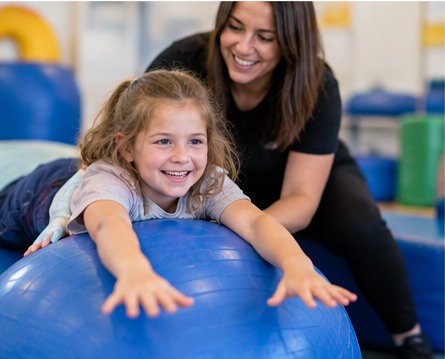

What This Means for Your Child
- Communication support in real school routines
- Sensory and regulation strategies
- Fine-motor and functional participation
- Skills that generalize beyond the therapy room
At A-FITS, Speech and Occupational Therapy are not separate programs that happen somewhere outside the student's educational experience. They are part of the school day.
Our approach is based on a simple observation: learning a skill and using that skill independently are not always the same thing.
A student may successfully demonstrate a communication, regulation, social, or motor skill while working one-to-one with a therapist in a quiet room. But when that student returns to the classroom, playground, lunchroom, or another environment, using the same skill can become much more difficult.
For students with autism, generalizing a learned skill across different people, settings, activities, and situations can be challenging.
That is why A-FITS emphasizes providing Speech and OT support within the student's natural school environment.
Speech & Communication
Communication is essential to learning, relationships, self-advocacy, and independence.
Speech and language support at A-FITS can help students strengthen functional communication, receptive and expressive language, social communication, classroom participation, conversation skills, and the ability to communicate wants, needs, ideas, and emotions.
For one student, that may mean learning how to appropriately ask for a break. For another, it may mean participating in a classroom discussion. Another student may be working on understanding directions, navigating conversations with peers, advocating for themselves, or communicating during a moment of frustration.
The goal is not simply for the student to demonstrate the skill to a therapist.
The goal is for the student to use that communication skill when they actually need it.
Occupational Therapy
Occupational Therapy supports many of the skills students need to successfully participate in everyday school life.
At A-FITS, OT support may address sensory regulation, fine-motor development, handwriting, motor planning, organization, classroom routines, self-care, functional participation, and increasing independence.
For many students with autism, sensory and motor needs can directly affect attention, regulation, communication, and access to learning.
OT helps us look beyond what we see on the surface and ask a more useful question:
“What is making participation difficult, and what support could make it more accessible?”
Why We Use a Natural-Environment Model
Traditional therapy often involves taking a student out of the classroom and working individually in a separate therapy room.
There can absolutely be value in one-to-one instruction.
But at A-FITS, we found that a student could learn a skill successfully in that controlled environment and still have difficulty using the same skill once they returned to everyday life.
That gap is called generalization.
Students with autism may have difficulty transferring a skill learned with one person, in one room, or during one activity to another person, environment, or situation.
Our response was to bring more of the support to the environment where the skill needs to occur.
Push-In Support: Practice It Where You Use It
A-FITS emphasizes a push-in therapy model whenever appropriate.
Speech and OT professionals can work with students in classrooms, sensory spaces, during activities, transitions, social situations, and other naturally occurring parts of the school day.
A communication skill can be practiced during an actual classroom lesson. A social skill can be supported while the student is interacting with peers. A regulation strategy can be taught during the type of transition that is difficult for the student. A fine-motor skill can be addressed while completing a real classroom activity. An independence skill can be practiced during the routine where the student will actually need it.
Instead of teaching the skill first and hoping the student later figures out how to transfer it, we can teach and reinforce the skill in the environment where it is meant to be used.
Speech and OT Are Part of A-FITS for Every Student
A-FITS also takes a different approach to determining who can benefit from Speech and Occupational Therapy support.
We have seen students arrive at A-FITS with meaningful communication, sensory, fine-motor, regulation, or functional needs even though they had previously been discharged from Speech or OT services or no longer met traditional qualification criteria in another educational setting.
That experience changed how we thought about support.
At A-FITS, we do not believe a student should have to demonstrate a significant enough deficit before they can benefit from therapeutic expertise.
Speech and OT support are incorporated into the A-FITS educational experience for all students, not only those who might traditionally qualify for isolated therapy services.
The level, focus, and type of support will naturally look different from student to student.
One Team. One Environment. Skills That Carry Over.
Our teachers, therapists, behavior staff, and support staff are not working toward separate versions of success.
They are supporting the same student throughout the same school day.
That allows strategies to be shared, reinforced, adjusted, and practiced across multiple environments and with multiple people.
Ultimately, our goal is not to help a student become successful in therapy.
Our goal is to help that student become more successful in life.